




-
Boat
- Dart
- Viper
- 49er
- Bimare S9
- Land Yacht
- Class A
- Dinghies
- F16/F18
- Flying Phantom
- Funboat
- Hobie cat
- KL
- Nacra
- New Cat
- Surprise
- Topaz
- Tornado
- Twincat
- Ventilo
-
Club Sails
- Land Yacht
- Compatible Dart 16
- Compatible Funboat
- Compatible Hobie Cat 15
- Compatible Hobie Cat 16 Standard
- Compatible Hobie Cat 16 Easy
- Compatible Hobie Cat Advance
- Compatible Hobie Cat Catsy
- Compatible Hobie Cat Dragoon
- Compatible Hobie Cat Teddy
- Compatible Hobie Cat Twixxy
- Compatible KL 10,5
- Compatible KL 13,5
- Compatible KL 15,5
- Compatible Laser
- Compatible Laser Pico
- Compatible New Cat 12
- Compatible New Cat F1
- Compatible New Cat F2
- Compatible Optimist
- Compatible Topaz 12
- Compatible Topaz 14
- Compatible Topaz 16
- Compatible twincat 13
- Compatible Twincat 15
- Compatible Twincat 15 Sport
- RS Feva
- RS
- WASZP France
- Sailor
- Boardsport
- Riders
- Blog
- Video
- La marque
It seems that you are in the wrong store
The country you have chosen is available for delivery but on another store. Please change your store to deliver to the country you want.

The chosen delivery country has no known delivery method.
Please send us an email to establish a personalized quote for your order. Thank you.
Laser sail: how to choose, trim and maintain your sail
The Laser, now known as ILCA within the international class, remains one of the most iconic single-handed dinghies in the world.
Simple to rig, easy to understand and highly demanding to master, it rewards precision more than approximation.
In this guide, we explain how Laser sails work, how to choose the right rig, which controls matter most, when to replace your sail and how to keep your boat performing consistently.
In this article
1. Why the sail matters so much on a Laser
2. Understanding Laser 4.7, Radial and Standard / Sport rigs
3. What makes a good Laser sail
4. The key controls: cunningham, vang, outhaul and mainsheet
5. When to replace your sail
6. Our Laser selection at Forward Watersports
Why the sail is central on a Laser
On a Laser, the sailor does everything.
You trim, steer, balance, accelerate and manage the power.
The sail is therefore the main engine of the boat.
A well-suited and well-trimmed sail helps you control the boat in stronger wind, accelerate in lighter conditions and maintain speed through transitions.
On the other hand, a tired, poorly tensioned or unsuitable sail can make the boat feel unstable, underpowered or unable to point properly.
“Olympic sailing I just have to win.”
Tom Slingsby, Olympic champion and multiple Laser world champion.
Understanding the different Laser rigs
The Laser exists in several rig configurations.
The hull remains similar, but the sail area changes according to sailor size, skill level and sailing conditions.
Laser 4.7
The Laser 4.7 is generally used by young sailors, lighter sailors or anyone looking for a sail that is easier to control.
Its smaller sail area limits power and makes it a good option for learning, improving technique and sailing with more confidence in medium to strong wind.
Laser Radial
The Radial offers a good balance between power, control and accessibility.
It is often chosen by intermediate sailors, lighter adults or racers who want a demanding boat without moving directly to the largest sail area.
Laser Standard / Sport
The Laser Standard, or Sport depending on commercial naming, uses a larger sail.
It requires more physical commitment and is better suited to stronger sailors or those looking for more speed and sensations.
What makes a good Laser sail?
A Laser sail should not only be judged by how clean or new it looks.
The key points are shape, leech, fabric, battens and the ability to keep repeatable settings.
Key points to check:
1. A stable overall shape
2. A clean and controlled leech
3. Fabric that has not stretched too much
4. Correct batten tension
5. Consistent feeling from one session to another
Overall shape
The shape of the sail defines its power.
A sail with a well-positioned draft generates drive while remaining controllable.
If the draft moves too far back, the boat becomes more physical and less stable.
If the sail is too flat or distorted, the boat may lack acceleration.
The leech
The leech is the back edge of the sail.
It affects airflow, power and acceleration.
A leech that is too closed can make the boat hard to steer.
A leech that is too open can reduce power.
The fabric
Over time, the fabric stretches.
This is normal.
But a sail that is too worn gradually loses its original shape.
It becomes harder to trim and less consistent in feel.
The battens
Battens stabilise specific areas of the sail.
Their tension must remain consistent.
A batten that is too tight can create an overly rigid shape.
A batten that is too loose can create folds or poor support.
The controls that change everything
ILCA explains that sail controls change the draft, depth and therefore the power generated by the sail.
This is especially true for the cunningham, vang, outhaul and mainsheet.
The cunningham
The cunningham controls luff tension.
It helps move the draft and control power.
As the wind increases, it helps flatten the sail and keep the boat more stable.
The vang
The vang controls leech tension and overall sail shape.
It is a major control on a Laser.
In stronger wind, it becomes essential to limit excessive leech opening and maintain control.
The outhaul
The outhaul controls the lower part of the sail.
The looser it is, the more depth the sail keeps.
The tighter it is, the flatter the sail becomes.
This helps adapt power to wind strength and water conditions.
The mainsheet
The mainsheet controls the angle of the sail to the wind.
It also affects leech tension.
On a Laser, it does not only pull the sail in or let it out.
It contributes directly to boat balance.
Performance: useful speed matters more than raw speed
A scientific study using GNSS data from 159 Olympic Laser sailors shows that VMG, meaning the speed made good towards the mark, is a key performance variable upwind and downwind.
This confirms a simple idea: a well-trimmed sail is not only about going fast.
It must also help you point, control the boat and reduce losses through transitions.
When should you replace your Laser sail?
A sail does not become unusable overnight.
It wears progressively.
Signs to watch:
1. Loss of shape
2. Unstable leech
3. Marked creases
4. Less consistent trimming
5. A boat that becomes harder to balance than usual
If your usual settings no longer give the same feeling, the sail may be part of the issue.
Before changing all the fittings or questioning your technique, check the real condition of the sail.
Accessories matter too
Performance does not only depend on the sail.
A deck cover protects the boat and reduces storage-related wear.
Precise batten tensioners make trimming easier.
Clean, protected and well-maintained equipment lasts longer.
Our Laser selection at Forward Watersports
At Forward Watersports, we offer a selection of products to equip and maintain your Laser.
The Laser Sport 7.1 m² sail is designed for sailors looking for a sail suited to sporty sailing.
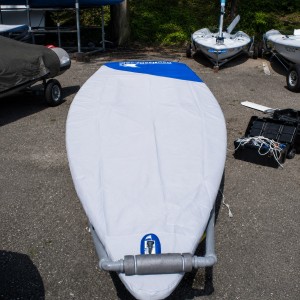
We also offer useful accessories such as a Laser deck cover and screw batten tensioners.
Sources
ILCA Sailing, Olympic Sailing: https://ilcasailing.org/olympic-sailing/
ILCA Sailing, Laser Cunningham – How to Trim: https://ilcasailing.org/laser-cunningham-how-to-trim/
Applied Sciences, GNSS Applications to Assess Performance in Olympic Sailors: Laser Class: https://www.mdpi.com/2076-3417/11/1/264
Nautical Channel, Tom Slingsby: from Laser to World Sailor of the Year: https://nauticalchannel.com/new/tom-slingsby-from-laser-to-world-sailor-of-the-year